
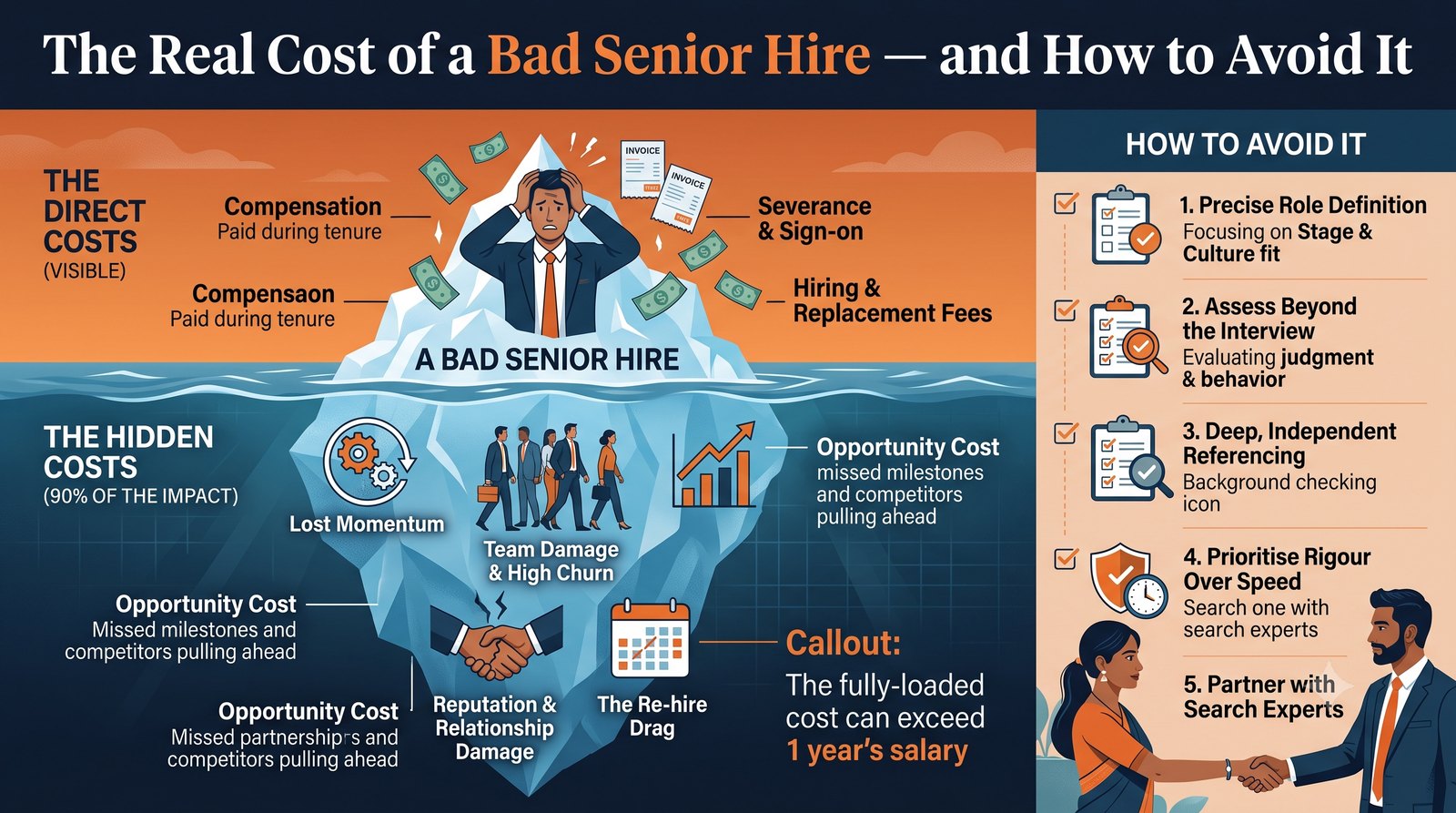
The direct costs
The visible costs of a failed senior hire are easy to tally and already substantial: the compensation paid during their tenure, any sign-on or relocation costs, severance, and the fees and time spent hiring them — then spent again to replace them. For a senior role, these alone often run to a large multiple of monthly salary before you've accounted for anything else.
The hidden costs
The costs that don't appear on any invoice are usually the larger ones:
- Lost momentum — the initiatives that stalled, the decisions delayed, the strategy that drifted while the wrong person held the seat.
- Team damage — good people disengage or leave under a poor leader. A bad senior hire can trigger departures well beyond the individual.
- Opportunity cost — the market moved, the competitor advanced, the deal wasn't done — because the leadership wasn't there.
- Reputation and relationships — clients, investors, and partners notice leadership churn, and it erodes confidence.
- The re-hire drag — months more of a vacant or badly-filled role while you search again.
Why senior hires fail
Senior hires rarely fail on technical competence — that usually gets checked. They fail on the things that are harder to assess in a rushed process:
- Culture and values mismatch — capable, but wrong for how your organisation actually works.
- Stage mismatch — succeeded at a very different company size or maturity than yours.
- Over-reliance on the interview — a polished interviewer isn't the same as a strong operator.
- Weak referencing — skipping or rushing the one step that most reliably surfaces risk.
- Speed over rigour — hiring against a deadline rather than against a standard.
How to reduce the risk
You can't eliminate hiring risk, but you can substantially reduce it: define the role and the ideal profile precisely before you start; assess for judgment, culture, and stage-fit — not just credentials; reference deeply and independently; and resist the pressure to rush a senior decision. Using an experienced search partner for critical roles adds a layer of structured assessment and market knowledge that materially lowers the odds of an expensive mistake.