
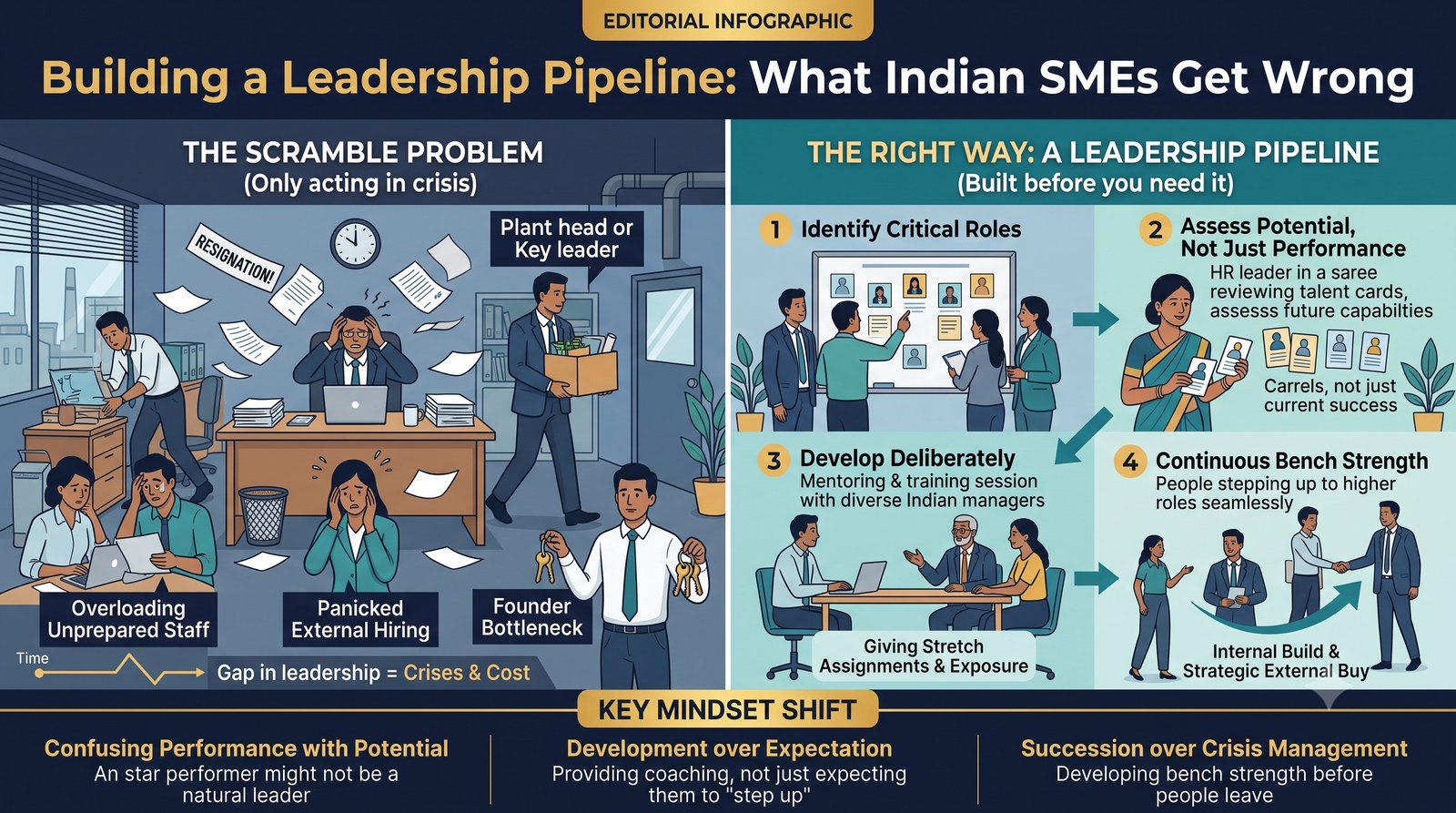
The scramble problem
The pattern is familiar: a business runs lean and effective, a key leader — a plant head, a sales director, a founder's right hand — resigns or is poached, and suddenly there's a hole with no one ready to fill it. The company scrambles, either overloading someone unprepared or hiring externally in a rush. Both are expensive. A leadership pipeline is simply the discipline of developing the next layer before that day arrives.
What SMEs get wrong
- Confusing performance with potential — the best individual contributor isn't automatically the best future leader; the skills are different.
- No development, just expectation — assuming people will "step up" without ever giving them the exposure, coaching, or stretch to grow into leadership.
- Founder bottleneck — decisions and relationships concentrated in one or two people, so no one else is ready to lead.
- Treating it as an HR project, not a business priority — pipelines built without genuine leadership commitment fade.
- Only acting when someone leaves — by definition, too late.
How to build a pipeline
A practical approach doesn't require a large HR function:
- Identify critical roles — the handful of positions where a sudden vacancy would genuinely hurt.
- Assess potential, not just performance — who has the capability and appetite to grow, using structured potential assessment rather than gut feel.
- Give real stretch — exposure to bigger decisions, cross-functional projects, and controlled responsibility ahead of the title.
- Develop deliberately — targeted training, mentoring, and coaching aimed at the specific gaps.
- Review regularly — treat bench strength as a standing leadership conversation, not an annual form.
Build vs. buy
You won't develop every leader internally, and you shouldn't try to — some capabilities and fresh perspective are best brought in from outside. The goal is balance: a pipeline strong enough that you're not forced into a panicked external hire, combined with the judgment to recruit externally when the role genuinely needs new blood. Companies that do both well are rarely caught flat-footed by a resignation.