
Why 'satisfaction' isn't ROI
The most common training metric — a feedback form asking whether people enjoyed the session — measures satisfaction, not impact. People can love a workshop and change nothing about how they work. Conversely, uncomfortable training that genuinely shifts behaviour may score poorly on the day. If you're reporting training success on attendance and smile-sheets, you're measuring activity, not outcome.
The four levels of measurement
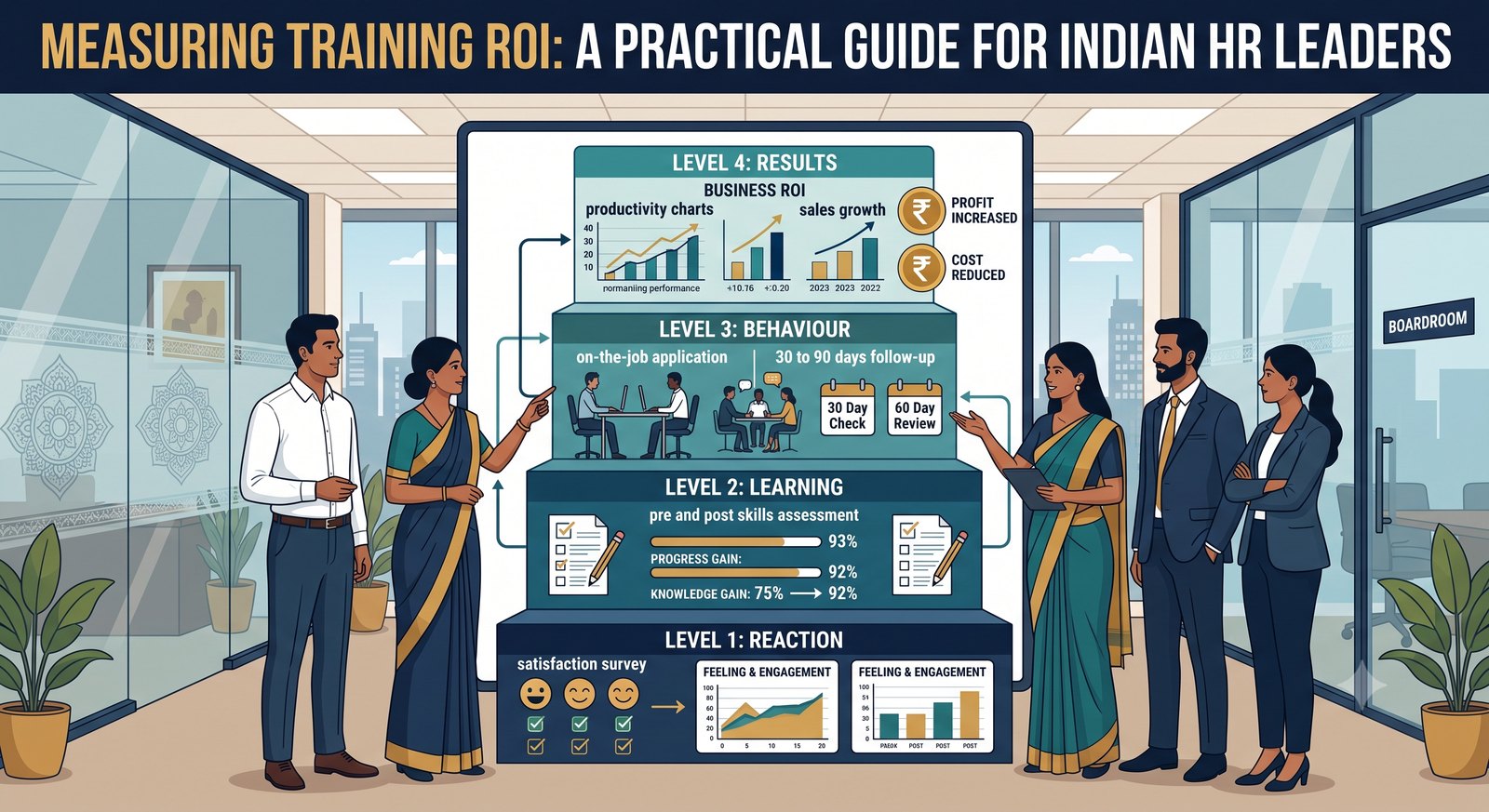
A widely-used framework (the Kirkpatrick model) measures training at four ascending levels, each more meaningful than the last:
- Reaction — did participants find it relevant and engaging? (the happy-sheet)
- Learning — did they actually gain the knowledge or skill? (assessment before and after)
- Behaviour — are they doing something differently at work weeks later? (the crucial, most-skipped level)
- Results — did it move a business metric — productivity, quality, retention, sales?
Start with a baseline
You can't prove improvement without knowing the starting point. Before a programme runs, capture the baseline for whatever you intend to move — the sales conversion rate, the quality error rate, the engagement score, the specific competency level. Without that baseline, any post-training number is just a number with nothing to compare it to.
A practical approach for Indian teams
You don't need an elaborate analytics function to measure training meaningfully. A practical sequence:
- Define the business outcome first — what should change, and how would you see it in the numbers?
- Baseline it — capture the metric before the programme.
- Assess learning — a simple before/after check of the actual skill or knowledge.
- Measure behaviour at 30–90 days — manager observation or a structured check-in on whether the behaviour changed on the job.
- Compare the outcome to baseline — and attribute honestly, acknowledging other factors.
Designing training with measurement built in from the start — rather than bolted on afterwards — is central to how effective training & development programmes are built. If the outcome can't be described before the programme runs, that's the first thing to fix.